
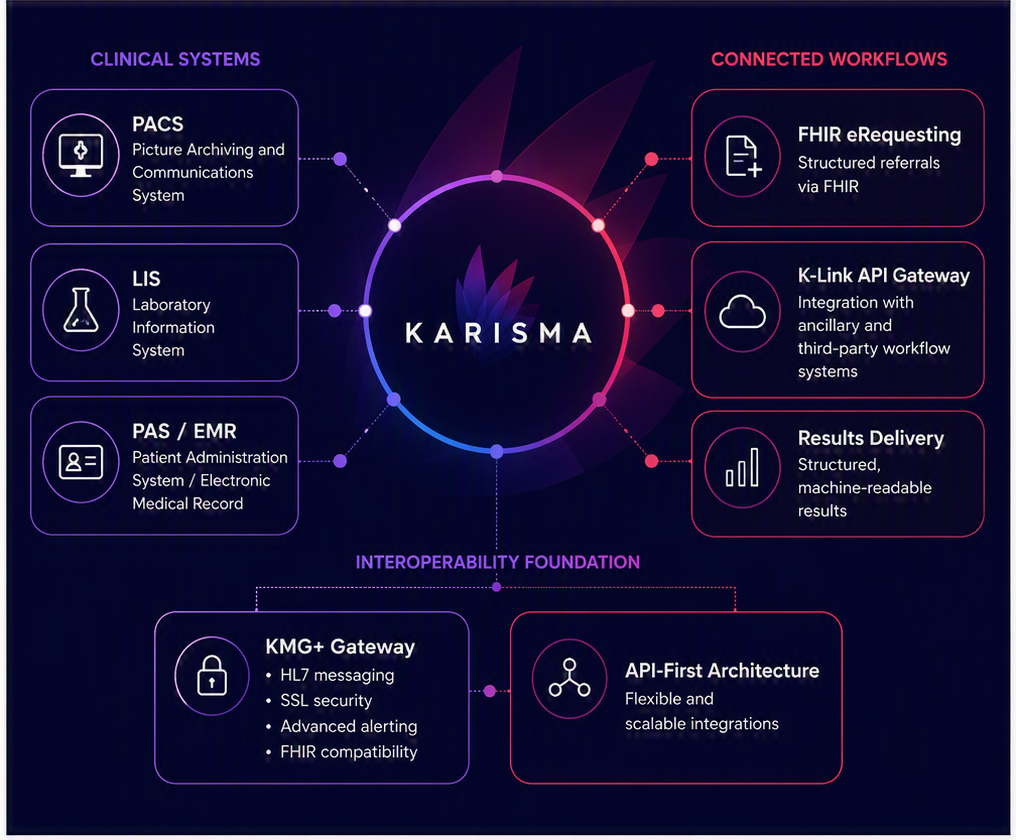
Interoperability in healthcare is the ability for clinical systems to exchange and use information in a consistent format across every stage of the patient journey. For radiology and pathology practices across Australia and New Zealand, that connectivity is the difference between workflows that run cleanly and ones that do not. In short, when systems cannot share data, staff spend their day bridging gaps the technology should be closing. When systems cannot share information reliably, the problems are visible everywhere: delayed results, duplicated data entry, referrals that arrive incomplete, and clinicians making decisions without the full picture. Karisma is built to support a connected clinical environment. Kestral’s work on interoperability, from HL7 and K-Link through to live FHIR eRequesting, reflects that commitment across every part of the platform.
What Is Interoperability in Healthcare?
Interoperability in healthcare is the ability for multiple systems operating in the same environment to exchange and use information in a consistent format, in a way that adds clinical value at every stage of the patient journey. It is the difference between a connected care environment where data moves with the patient, and a fragmented one where staff spend time bridging the gaps manually.
This matters most in settings where multiple departments or providers are involved in a single patient’s care. In a hospital, radiology, pathology and emergency departments may all need the same patient record at different points in the care pathway. Having that information available at the right time creates a cohesive experience for patients. It also creates a workable one for clinical staff.
In private practice, the same principle applies. A radiology practice that cannot receive structured referral data, return results in a usable format or connect its RIS to adjacent systems is carrying a workflow burden its patients and referrers will eventually notice.
How Does Healthcare Interoperability Actually Work?
Data moves between clinical systems through a range of transport methodologies, and the right approach depends on the type of data being exchanged and the security requirements around it.
HL7 (Health Level 7) has been the established standard for connecting health information systems including RIS, LIS, PAS and EMR platforms for decades. It enables faster, more secure data exchange across systems that would otherwise operate in isolation. Kestral’s KMG+ gateway builds on this foundation, adding SSL security capabilities, advanced alerting on messaging events and compatibility with emerging standards including FHIR.
For practices that need a more sophisticated level of integration, Kestral’s K-Link API Gateway enables connection to ancillary workflow systems beyond the core clinical environment. This type of integration gives practices the flexibility to build workflows around their specific needs. They are not confined to the limitations of a single system.
For full detail on K-Link and the Karisma API, see Frequently Asked Questions: Interoperability in Healthcare
What Role Do Standards Play in Healthcare Interoperability?
Standards are what make interoperability scalable. Without them, every integration between systems requires custom development, which is costly, slow and difficult to maintain as systems evolve.
HL7 has served as the foundation for healthcare data exchange for many years and remains central to how most clinical environments operate today. FHIR (Fast Healthcare Interoperability Resources) is the next evolution. It brings a modern, API-based approach to health data exchange. This is better suited to the connected, digital-first care environment emerging across Australia and New Zealand.
Kestral is an active participant in that evolution. Across both radiology and pathology, Kestral is contributing to how FHIR standards are being adopted and implemented in the Australian market, working alongside the broader healthcare community to ensure the standard delivers real clinical value in practice, not just in theory.
For a full explainer on FHIR see here What is FHIR and Why does it Matter for Healthcare in Australia?
How Is Kestral Delivering FHIR eRequesting Today?
FHIR eRequesting is live in Karisma through an integration with Magentus. For practices ready to move to structured electronic requesting, the process is straightforward: contact Magentus to initiate the integration, and Kestral handles the technical implementation from there.
This is a meaningful step forward for practices managing referral workflows. Structured eRequests carry clinical information in a consistent, machine-readable format, reducing the manual handling and interpretation that comes with unstructured referrals. For booking staff, that means fewer calls to clarify referral details. For clinicians, it means the information they need arrives in a usable form.
The integration reflects a broader direction for Kestral. Interoperability is not a feature to be added later. It is foundational to how Karisma is built, and FHIR eRequesting is the clearest current example of that commitment in production.
What Does a Fully Interoperable Environment Mean for Radiology and Pathology Practices?
A fully interoperable environment means clinical data moves with the patient across every touchpoint, without manual intervention to bridge system gaps. Results are returned in structured formats that receiving systems can use directly. Referrals arrive with the clinical context intact. Workflows between departments, between practices and between providers operate on shared data rather than copied or re-entered information.
For practice owners and managers, the operational impact is tangible. Staff spend less time on administrative workarounds. Errors that stem from transcription or miscommunication are reduced. As a result, the practice is ahead of the standards Australian and New Zealand healthcare is moving toward, rather than scrambling to catch up when they become mandatory.
Kestral’s approach to interoperability covers HL7 and K-Link through to live FHIR eRequesting. However you are positioned today, that architecture supports the transition at every stage.