
FHIR (Fast Healthcare Interoperability Resources) is the emerging global standard for electronic health data exchange, and its adoption across the Australian healthcare system is already underway. This FAQ explains what FHIR is, why it represents a significant step forward from legacy standards, and what it means for radiology and pathology practices operating in Australia and New Zealand today.
Frequently Asked Questions: FHIR and Healthcare Interoperability
What is FHIR?
FHIR (Fast Healthcare Interoperability Resources) is a modern standard for exchanging healthcare information electronically. It provides a flexible, secure and efficient framework for ensuring the right clinical information is accessible to the right people at the right time. Developed through a collaborative, iterative process with input from global healthcare stakeholders, FHIR uses an API-based architecture and modern data formats that integrate cleanly with contemporary health information systems.
Why is FHIR needed when HL7 already exists?
HL7 has served as the foundation for healthcare data exchange for decades and remains in active use across most clinical environments in Australia and New Zealand today. However, legacy HL7 standards were not built for the demands of modern healthcare. They rely on plain-text messaging that carries security risks, follow a rigid single-paradigm approach to data exchange, and do not support modern data requirements such as current gender identity attributes or Australian-specific provider information. FHIR addresses these limitations with an open, API-based framework that is more secure, more flexible and better suited to the connected digital healthcare environment Australia is moving toward.
See Frequently Asked Questions: Interoperability in Healthcare for broader context.
How does FHIR actually work?
FHIR enables health systems to communicate directly with each other, securely and efficiently, without requiring patient data to be locked in a central repository. Clinical information follows the patient, accessible to authorised providers across different systems and settings. This architecture powers practical innovations including electronic health records, ePrescriptions, eRequesting and comprehensive patient summaries that improve care coordination across the full clinical pathway.
What makes FHIR different from previous interoperability standards?
Several characteristics distinguish FHIR from earlier standards. Its API-based framework enables secure, flexible data exchange across multiple access paradigms and promotes the use of common code sets nationally. It uses self-describing XML and JSON data formats that integrate with modern systems without custom translation layers. It incorporates patient consent directly within the data model, supporting ethical and secure data sharing. And it was developed openly, with global input, meaning it benefits from broad clinical and technical expertise.
What are the benefits of FHIR adoption for Australian healthcare?
National FHIR adoption delivers benefits at both the system and practice level. At the system level, it reduces inefficiencies through standardised codes for diagnoses, requests and workflows across the country. It improves data security through advanced encryption and secure APIs. It draws on implementation experience from countries including the United States, the United Kingdom and Canada, allowing Australia to adopt proven approaches while developing standards that address local healthcare requirements.
Where is Australia in its FHIR adoption journey?
Australia has made significant progress in its national FHIR implementation. The federal government has invested in the accelerated development of the Australian FHIR standard, and the initial release of minimum viable standards has now been completed. Adoption is underway across the healthcare system, with eRequesting representing one of the most active current workstreams. Radiology and pathology practices that engage with FHIR-capable systems now are positioning themselves ahead of what will become a baseline expectation across the Australian healthcare landscape.
How is Kestral involved in FHIR adoption in Australia?
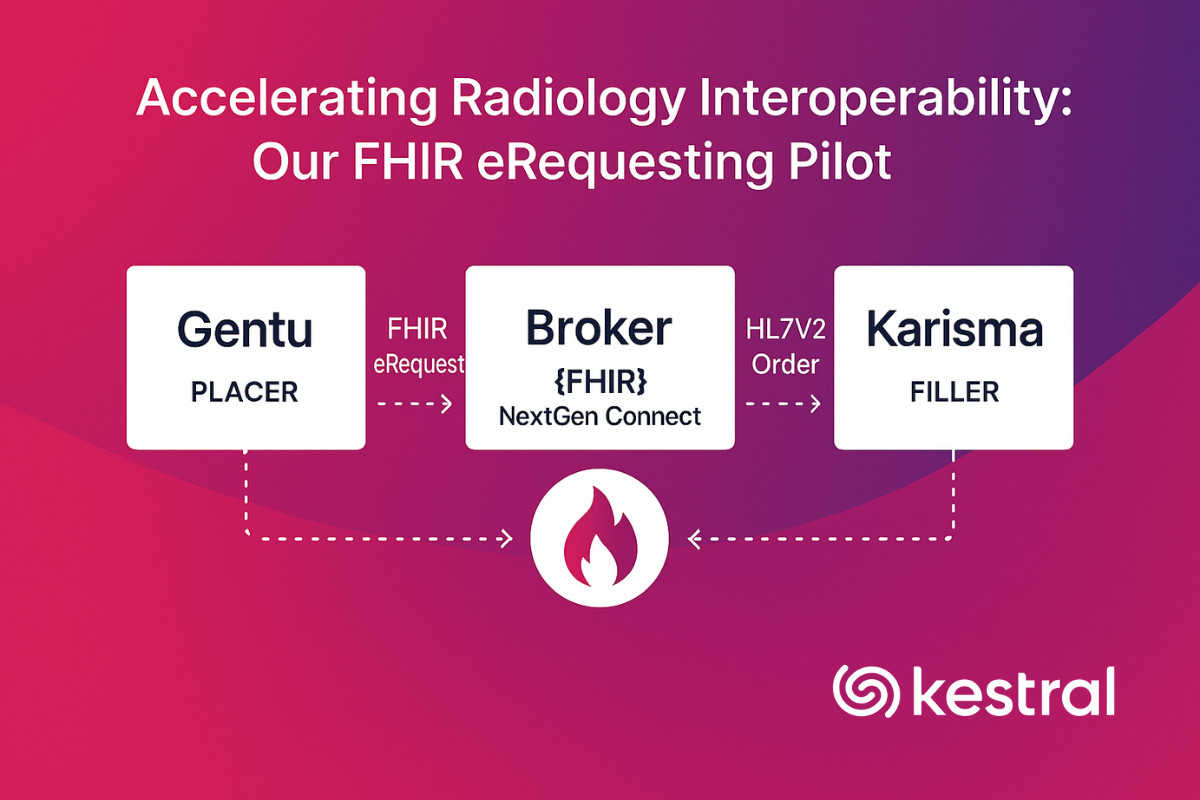
Kestral is an active participant in Australia’s FHIR adoption across both radiology and pathology. FHIR eRequesting is live in Karisma via integration with Magentus, enabling structured electronic requesting between GP systems and radiology practices. Beyond implementation, Kestral is engaged in how FHIR standards are being shaped and applied in real clinical environments.
See How Does Kestral’s API and K-Link Gateway Enable Smarter Integration for Radiology Practices? for more on Kestral’s integration architecture.
What does FHIR mean for radiology practices in practical terms?
For radiology practices across Australia and New Zealand, FHIR eRequesting means imaging requests arrive as structured, machine-readable data rather than unstructured documents requiring manual interpretation. Booking staff spend less time clarifying request details. Clinical information is more complete and accurate at the point of booking. And the practice is connected to a national data exchange framework that will underpin how requests, results and clinical records move across the healthcare system going forward. Ease of minimal-use standards are expected in 2025 and we are excited to see the next chapter of innovation unfold.